Major provisions of the Building Standards Act applicable to accommodation facilities under the Hotel Business LawFor those who are planning to open an accommodation facility based on the Ryokan Business Act In order to operate a lodging facility (hotel, inn, guesthouse, etc.) based on the Ryokan Business Act, the building in which the business is planned to be conducted must meet the structural and equipment standards stipulated in the Ryokan Business Act and the Fire Service Act. The Building Standards Act stipulates the zoning districts in which lodging facilities (including entrance halls outside facilities) can operate. Kyoto city ask that you confirm the zoning of the property before considering it, as follows. 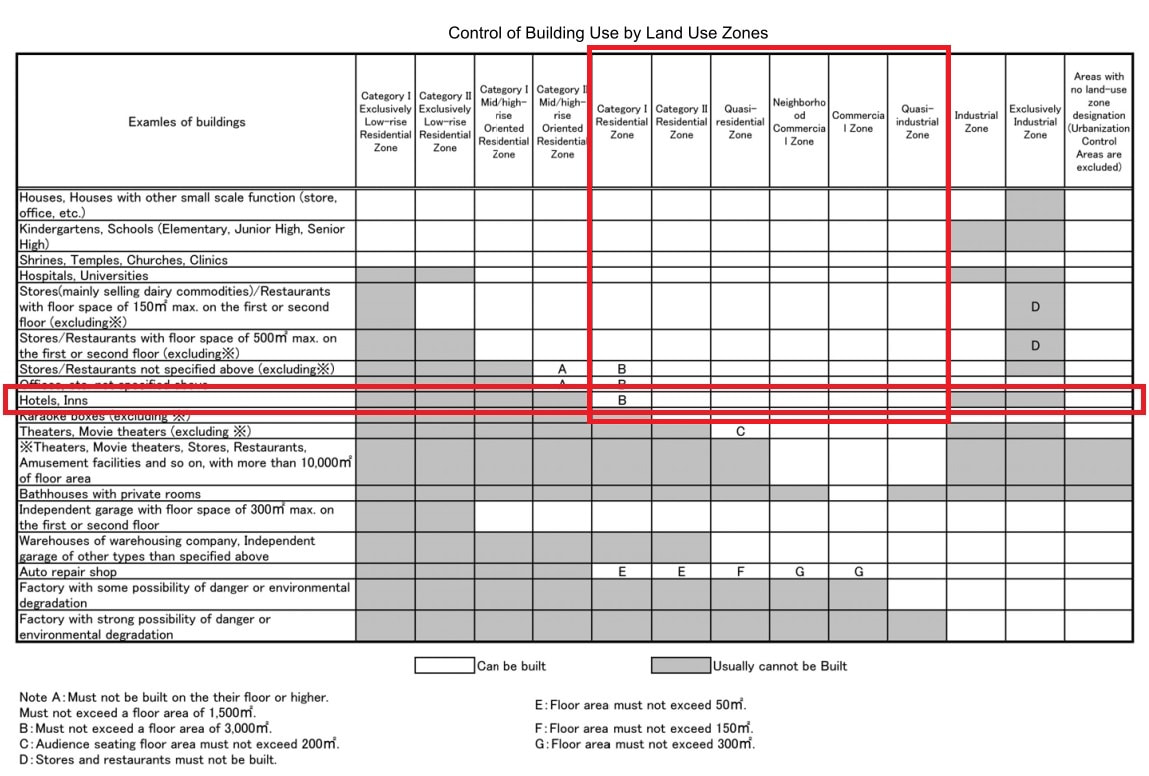 < Regulations Other than Zoning > When changing the use of an existing building and using it as a lodging facility, even if no building permit is required (e.g., area less than 200m², not involving expansion, renovation, or major repair or redecoration), it is necessary to comply with various provisions of the Building Standards Act. Please refer to the following main provisions of the Building Standards Act for the details of the regulations. In addition, before using the facility as a lodging facility, it is necessary to complete the necessary procedures based on the Barrier Free Ordinance. Major provisions of the Building Standards Act applicable to accommodation facilities under the Hotel Business Law - As a general rule, buildings on alley-shaped site* (see explanation below) cannot be changed to inns. 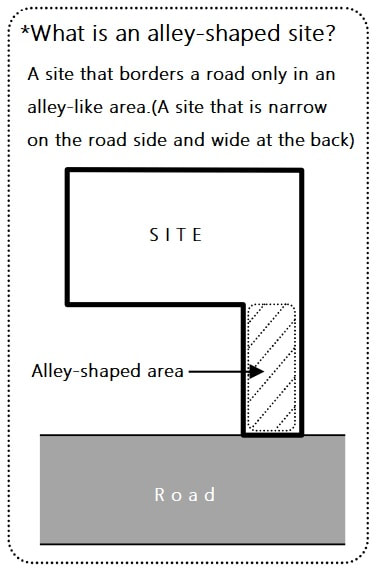 - If the existing building does not conform to the provisions of the Building Standard Act, it is necessary to change the use of the building after the illegal part is removed. - In principle, the building must be fireproof when changing the use of the third floor or more to an inn. Even if the building is not a fireproof building (limited to 3 stories and less than 200m² in total area), it is necessary to install a pit compartment and alarm system. *An automatic fire alarm system or an automatic fire alarm system for specified small facilities with a receiver is required. This is not a residential fire alarm system. **Linen rooms and employee offices are also "ryokan uses". - If there is fire use, ventilation equipment must be installed. - Emergency lighting must be installed. - The site passage (passage from the exit of the building to the road, etc.) must be 1.5m or more (From April 2020, 0.9m or more for buildings with 3 or less floors and a total floor area of less than 200m²). - The width of alleys, etc. must be at least 1.5m regardless of the size of the building, as in the past, for buildings to be used as accommodation facilities in accordance with the provisions of 9-67 of the Kyoto City Building Law Handbook. - For rooms without windows, the walls, etc. that separate the rooms must be made of fireproof or noncombustible materials. * In addition to guest rooms, rest rooms and kitchens are also "rooms". - In the case of a change of use of a row of buildings (attached houses) to an inn (including a partial change of use), the boundary wall between the row of buildings and the inn shall be a partition wall for fire prevention. It is necessary to use a wall of quasi-fireproof construction and compartmentalize it to the shed or ceiling. - In addition, depending on the floor area and other factors, it may be necessary to install two or more direct staircases, smoke exhaustion equipment, interior restrictions, etc. - If the building is to be expanded, remodeled, repaired, or redecorated, it must also comply with road access and structural regulations. - There are cases where procedures based on the Building Standards Act are required even when only renovations are to be done. Confirming whether or not a building complies with the Building Standards Act requires specialized knowledge. Even if you do not need to apply for a building permit, , if necessary, please consult with an architect or other professional to ensure that your plans and construction are carried out legally. The responsibility for using a building in violation of the law lies with the construction client (business) or building owner. Supplement for those who are planning to open an accommodation facility based on the Ryokan Business Act For inns with three floors and a total area of less than 200 m². 1 Overview With the enforcement of the revised Building Standards Act in June 2019, buildings with three floors and a total floor area of less than 200m² can be used as inns, etc., without having to be fireproof buildings, provided that alarm systems and certain compartments are installed. 2 Precautions (*Please be sure to check the following. In the case of a change of use of 200m² or less (not involving expansion, renovation, or large-scale repair), no application for building certification is required. However, due to the change of use, the provisions of the Building Standards Act will apply, and it will be necessary to comply with various regulations. Specialized knowledge is required to investigate whether or not these buildings comply with the Building Standards Act. Even if you do not need to apply for a building permit, please be sure to consult with an architect or other specialist before legally carrying out any planning or construction work. The responsibility for using a building in violation of the law lies with the construction client (business) or building owner. 3 Necessary actions (1) Alarm system An automatic fire alarm system or an automatic fire alarm system for specified small facilities with a receiver is required. This is not a residential fire alarm system. (2) Pit compartment a. Overview The stairs and other parts of the building must be separated by partition walls and doors. b. Form of stairs The staircase must be a "direct staircase" and the stairs from the third floor to the first floor must be connected without interruption. It is not possible to pass through the living room on the way, nor is it possible to have a door. c. "Partition walls" and "Doors" The Ministry of Land, Infrastructure, Transport and Tourism (MLIT) gives the following examples in their explanation Partition walls: Partition walls with plasterboard of 9.5 mm or more in thickness on both sides Door: Flush door (with self-closing mechanism and smoke blocking performance, etc.) * You cannot use fusuma, shoji, walls made of plywood of about 3 mm thick, or doors made of plain glass. Examples of non-direct staircases and their responses 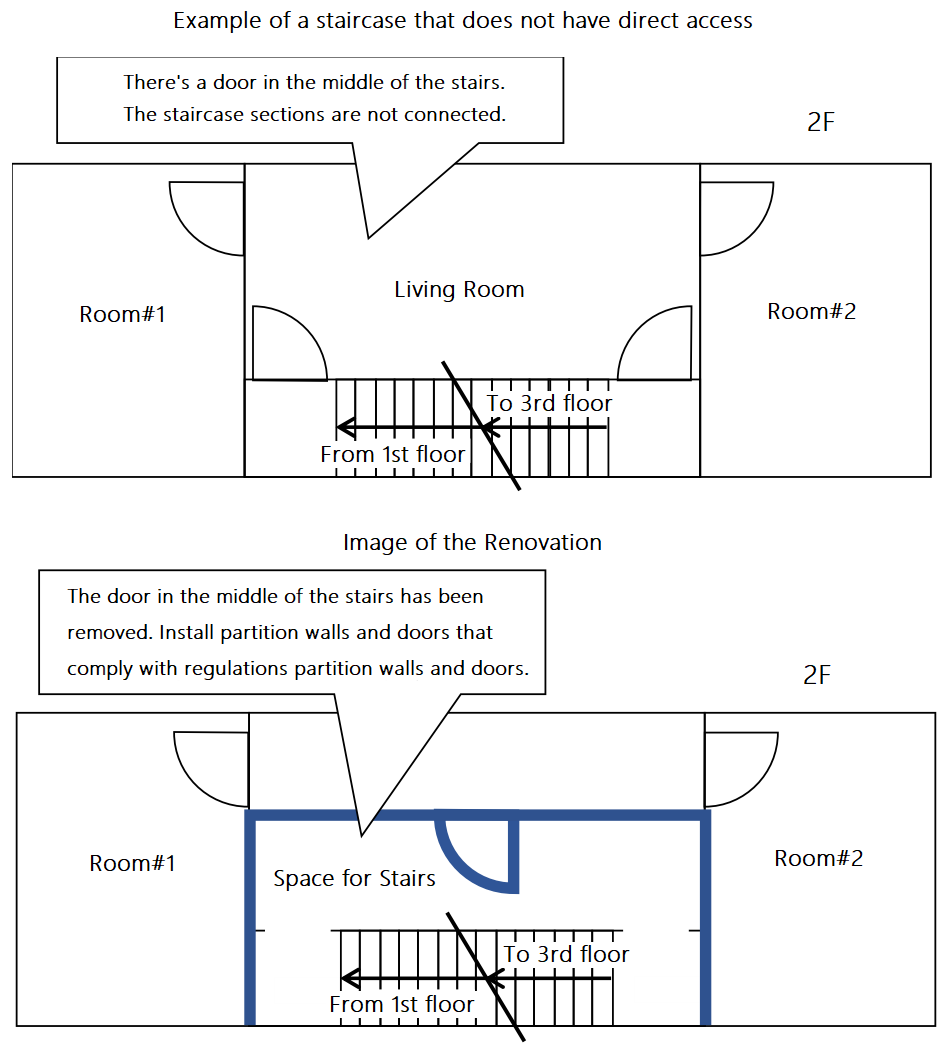 Inns and Hotels ActThe Inns and Hotels Act is a law set forth for the purpose of contributing to improve public health and people's lives through promoting the provision of services that cope with enhancement and diversification of the user's demands in the hotel business field, while planning to develop sound hotel businesses by securing appropriate operation in the hotel business. The Hotel Business is defined as "a business that lodges a person for a fee" and "lodging" is stipulated as "to use a facility by using bedding" in this law. In order to operate this hotel business, it is stipulated that obtaining permission in accordance with the Inns and Hotels Act is required. In addition,the hotel business differs from the room renting business, including apartments, concerning the following points. (1) Responsibility on maintaining and managing the cleanliness of the facility, including the rooms for lodgers, is universally accepted to be on the operator, considering from point of facility management and operation form in general, and (2) the room of the facility that the lodger uses is not the principal place of residence for that person. Even if housing are used for lodging, obtaining permission in accordance with the Inns and Hotels Act is required, since conducting a "Private Lodging Business" that provides lodging repeatedly for a fee basically falls under the hotel business. There are several types of permission in accordance with the Inns and Hotels Act, however, obtaining permission for operating simple lodging is common if conducting a private lodging business without registration. (Hotel Business Classification) 1. Hotel Operation (*) Operation, where a facility mainly consisting of western style structure and equipment is established, and accommodates it to a person for a fee. 2. Inn Operation (*) Operation, where a facility mainly consisting of Japanese style structure and equipment is established, and accommodates it to a person for a fee. 3. Common Lodging House Operation Operation, where a facility consisting of structure and equipment is established for several persons to share, and accommodates it to a person for a fee. (pension, youth hotel, etc.) 4. Boarding House Operation Operation, where a facility is established, and accommodates it to a person for a fee on a monthly basis. (*) Hotel operation and inn operation will be integrated as "inn and hotel operation" from June 15, 2018 as "operation, where a facility is established, and accommodates it to a person for a fee excluding simple lodging operation and boarding house operation". The structure equipment of the facility to be used needs to meet the standard upon obtaining permission. In addition, application to the prefectural (including the city that establishes a health center and special zone) health center, where the facility (housing) expected to conduct the Private Lodging service is located, is required. Permission standard for simple lodging (standard on minimum floor area) was relieved in April, 2016 and obtaining its permission has become easier than before.  Cases Not Applicable to the Inns and Hotels ActThere are some cases that do not apply to the Inns and Hotels Act, even if they are providing lodging services using housing. Some examples are as follows.
■In case of providing one's house in accordance with a local government's request when an event is held (Government Notification in July 2015) ⇒ To solve the shortage of lodging facilities in an area, when lodging facilities run short for an event that is expected to attract many customers, event-private-lodging enables travelers to stay in facilities which are originally not lodging facilities. The event-private-lodging is expected to be effective from the viewpoint of local creation through tourism, as it leads to promoting interaction between the people of the area and travelers, as well as expanding tourism consumption in the area. ■Short-term residence to vacant house properties with the purpose of buying and selling or leasing to a person wishing to move (Government Notification in March 2016) The Inns and Hotels Act will not apply to a short-term residence to a vacant house property from the assumption that it will be bought, sold or leased to a person wishing to move, if all of the following measures are taken. (1) The activity of using and utilizing the vacant property is placed in accordance with the Act on Special Measures on Promoting Countermeasures on Vacant Houses, etc. (Act No. 127 of 2014), and the subject of the facility is specified in a local public entity, such as when the local public entity that is to conduct such activity has registered the vacant property. (2) A person who is to purchase or lease the subject of the facility can be confirmed by the local public entity that such person truly has the will to purchase or lease such facility for long term. (3) It can be confirmed that the actual condition of the facility is secured from many and unspecified persons using it repeatedly and continuously, through taking the measures written in (1) and (2). ■In cases where a regional council and other entities commissioned from a local public entity does not receive value equivalent to the lodging fee from the lodger, but only receives value equivalent to counseling related to such hands-on experience (Government Notification in March 2016) In a case where a regional council or other entities commissioned from a local public entity does not receive value equivalent to lodging fee from the lodger, but only receives value equivalent to guidance related to hands-on experiences, expenses paid by a regional council or other entities to farmers and other persons that provide hands-on experience services for educational trips that are accompanied by hands-on experiences does not come under the Inns and Hotels Act, as such fees do not apply to lodging fees. Please contact your nearest health center to ask whether any matter comes under the Inns and Hotels Act. https://www.mlit.go.jp/kankocho/minpaku/overview/minpaku/law2_en.html
Today, we would like to explain the changes in the number of permits for Ryokan/Hotel industries and Private Lodging(AirBnb) in Kyoto, which we accidentally investigated.
Currently, there are no foreign tourists due to the COVID-19. The number of foreign tourists visiting Japan in April, which had been announced by the Japan National Tourism Organization (JNTO), decreased by 99.9% compared to the same month last year, and the total number of foreign guests staying in Kyoto in April decreased by 99.7% compared to last year. Even if it includes domestic customers, it is a 95.7% decrease, which is a difficult situation. It became a popular travel city until last year, and many hotels were constructed or converted in parallel. We will share information together to understand the current state of such buildings. First of all, the ryokan business method is divided into the hotel business, the ryokan business, the budget hotel business, and the lodging business. Please check with the following criteria.
Structural facility standards for the budget hotel business and the hotel/ryokan business
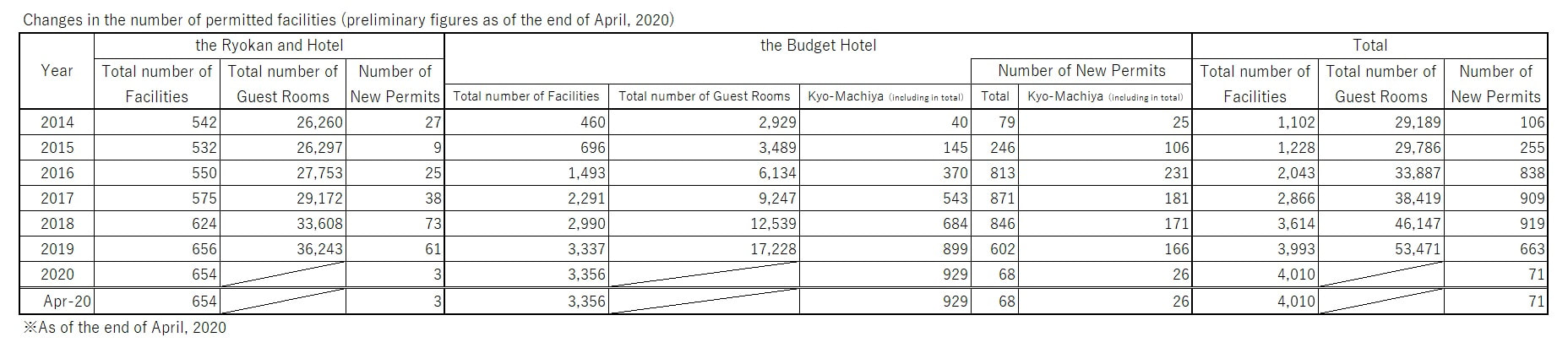
The following is the transition data for the number of permitted facilities such as the number of hotels and guest rooms in Kyoto City.
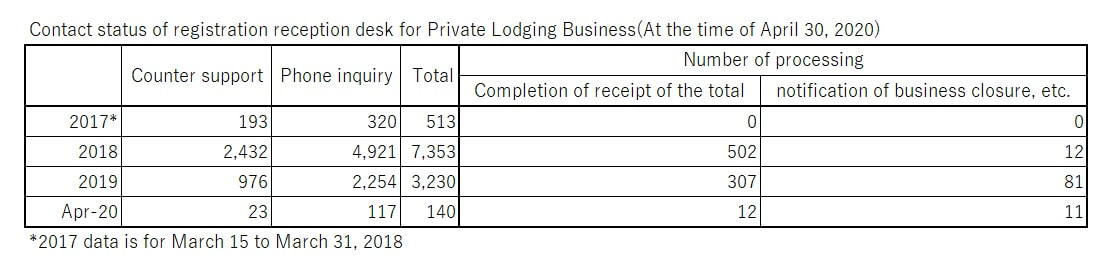
In addition, the following is the data on the status of correspondence with the registration reception desk of the private lodging business.
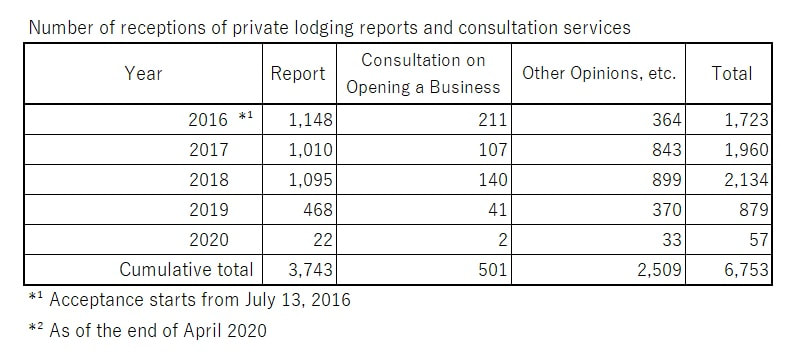
On the other hand, there was data on the number of consultations for reporting/opening the private lodgings.
In fact, in addition to the above data, there were surveys of facilities suspected of unauthorized business. If you are worried about such numbers, please check once.
|
AuthorArrows International Realty Corp. Archives
June 2023
Categories
All
|
|||||||||||||||||||
 RSS Feed