Request a Real Estate Agency to Act as an Intermediary.When purchasing a home, it is important to gather information on properties. In addition to gathering information on individual properties on your own using the Internet or information magazines, it is also effective to ask a real estate agent who has a lot of information on properties and the local area to help you find a property.  Point 1: Services provided by real estate companies in the brokerage business When looking for a brokered property, have the real estate company that acts as an intermediary between the seller and the buyer, called a brokerage firm, look for the property. The real estate company provides information on properties that meet the conditions of the prospective buyer, and then supports the entire real estate transaction, including on-site visits, negotiations with the seller on terms and conditions, property explanations (explanation of important matters), contract procedures, and delivery procedures (on-site attendance, settlement of payment and expenses, etc.). Advice can also be sought on specialized areas such as law and taxes. It is difficult for non-expert parties to directly negotiate a contract with the seller, but by having a real estate company, a professional in real estate transactions, act as an intermediary, negotiations can be expected to proceed smoothly. If there are any uncertainties, it is advisable to consult with a real estate company. Brokerage fees are charged for such support services for the entire real estate transaction. 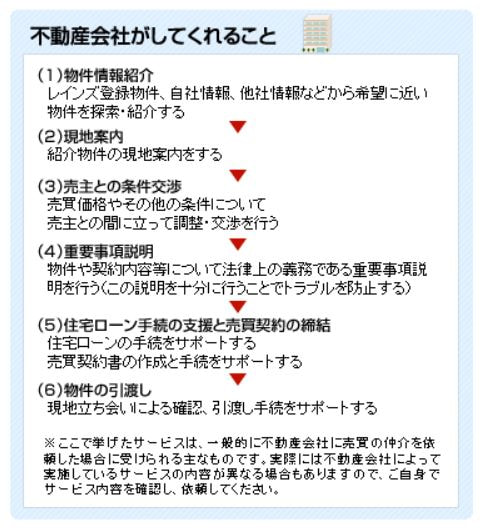 What a real estate company does for you (1) Provide property information Search and introduce properties close to what you desire from REINS-registered properties, its own information, other companies' information, etc. ▼ (2) Provide on-site tours Provide on-site tours of selected properties ▼ (3) Negotiate terms and conditions with the seller Coordinate and negotiate with the seller regarding the purchase price and other terms and conditions ▼ (4) Explanation of important matters Provide a legally obligated explanation of important matters regarding the property, contract details, etc. (This explanation will prevent potential problems in the future.) ▼ (5) Assist with mortgage loan procedures and execution of the purchase agreement Assist with the mortgage loan process. Assist in the preparation and conclusion of the purchase agreement. ▼ (6) Delivery of property Assist with verification and handover procedures by being present at the site.  Point 2: Check the differences in services offered by different real estate companies. In choosing a real estate company to find a property for you, it is important to first understand the business of the real estate company and fully confirm the services you will receive. Find out what services are available Next, examine the specific differences in the services provided by individual real estate agencies in terms of how they are provided. For example, if you feel that a real estate agency is not very proactive in providing property information, or if you feel that the explanation of service contents is "vague" or "lax," ask for an explanation until you are satisfied. After that, you can decide for yourself whether or not the real estate company is trustworthy and make your choice. The following checklist is an example of the things to check when choosing a real estate company. Make your final decision after thoroughly reviewing not only these items, but also any other concerns you may have. Brokerage Services Checklist 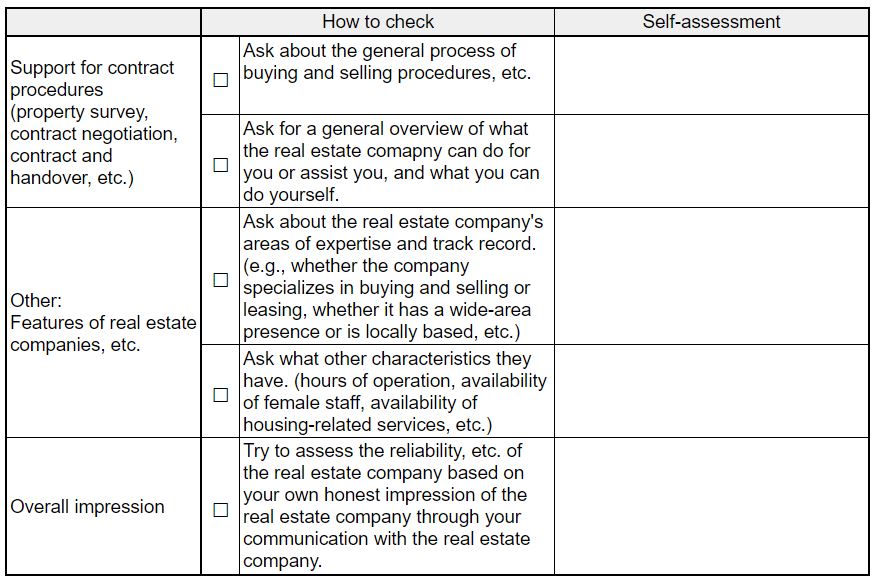 *This checklist is a reference for reviewing brokerage services and selecting a real estate company. Ultimately, please use your own discretion in selecting the real estate you request. Ask real estate companies to find a property for you. Real estate companies can search for property information from the extensive information database of "REINS*" operated by the designated distribution system, including information that other real estate companies have received requests to sell. They can also provide information on properties for sale by their own clients and through cooperation with other real estate companies. Just because a real estate company introduces you to a property does not mean that you must purchase it. It is also possible to stop the property search in the middle of the process or request other real estate companies to search for properties at the same time. First, gather a wide range of information from real estate companies. *REINS: The name of the computer network system (Real Estate Information Network System) operated by the designated distribution system.  Point 3: Tips for finding the right home Communicating the exact conditions of your desired home to the real estate company is often the fastest way to purchase a desired home. When asking the real estate company to search for a housing, you should tell the real estate company the "area," "type of housing," "budget," and "move-in period.
For the "area," it will be easier for the real estate company to find a property if you narrow down your search to the train line and nearest station. The type of property" includes whether it is a single-family home or a used condominium. For "Budget," set an upper limit and tell whether it is a "housing budget" or a "total budget for purchasing a house. Once you have communicated your desired conditions, ask the real estate company for advice on whether the conditions are reasonable, and narrow down your preferences to more specific conditions. If you are unable to find a property that meets your conditions, consider expanding the range of properties by changing the desired conditions that are lower in priority. If your initial preferences are not clear, you may want to clarify them by looking at property information. In this case, organize the conditions of the properties you like and communicate them to the real estate company while clarifying your desired conditions. Choosing a Real Estate AgencyFind out about real estate agencies When purchasing real estate, it is important to choose a reliable real estate company. It is especially important to work closely with a real estate company if you are looking for a brokered property. Start by first gathering some basic information about the real estate company.  Point 1: Learn about the characteristics of real estate companies. Real estate companies have a variety of characteristics. For example, a company with many branches may have an advantage in providing information using its own network or in dealing in remote areas. A company that has been in business for a long time in a particular area may also be well versed in a variety of local information, not limited to real estate. These characteristics of a real estate company cannot be formally determined by the size of the company. It is important to determine these characteristics by referring to the reputation of the neighborhood and ultimately through communication with the real estate agent's staff.  Point 2: Check basic information about the real estate company. Information on real estate companies can be obtained on the Internet and through other sources. When information is not available on the Internet, it may still be possible to obtain certain information from government agencies. It is a good idea to check basic information about the real estate company, as needed. You can also look up the real estate company you want to know about on Real Estate Japan, or search for a real estate company by area or train line. The following is some commonly available information on real estate agencies. Real Estate Business Transaction License Number In order to buy, sell, or broker real estate, a real estate transaction business license is required. Companies with offices (head office, branch, etc.) in multiple prefectures are licensed by the Minister of Land, Infrastructure, Transport and Tourism, and companies with offices (head office, branch, etc.) in only one prefecture operate under a prefectural governor's license. The license number is always listed in real estate advertisements, so be sure to check it. 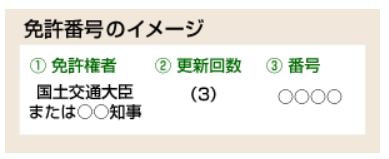 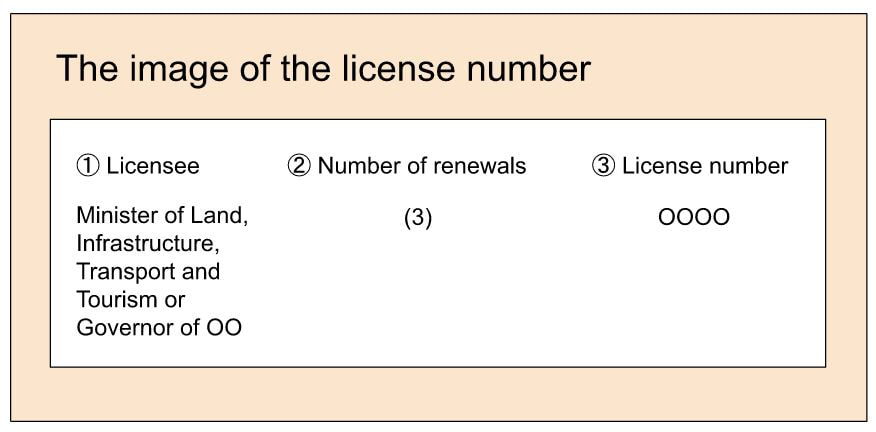 From the license number, you can confirm the licensor of the real estate agency (Minister of Land, Infrastructure, Transport and Tourism or prefectural governor) and the number of times the license has been renewed. Since licenses are renewed every five years, a company with a high number of renewals can be deemed to have a long history in the business and a certain level of experience, but there are also companies with a high level of know-how even if the number of renewals is low. The number of times the license is renewed should be checked as reference information when selecting a real estate company. Real Estate Agency Directory You can check the Real Estate Agents Directory at the administrative offices listed below. This roster includes the date of license, names of officers, locations of all offices (head office, branch offices, etc.), past administrative penalties, and the status of other concurrent businesses. This directory provides an overview of the real estate company. Some administrative agencies provide an overview of real estate agencies and information on administrative penalties on the Internet. However, you cannot judge a real estate company based on this information alone, so use it only as reference information when selecting a real estate company. Where to browse the Real Estate Agency Directory 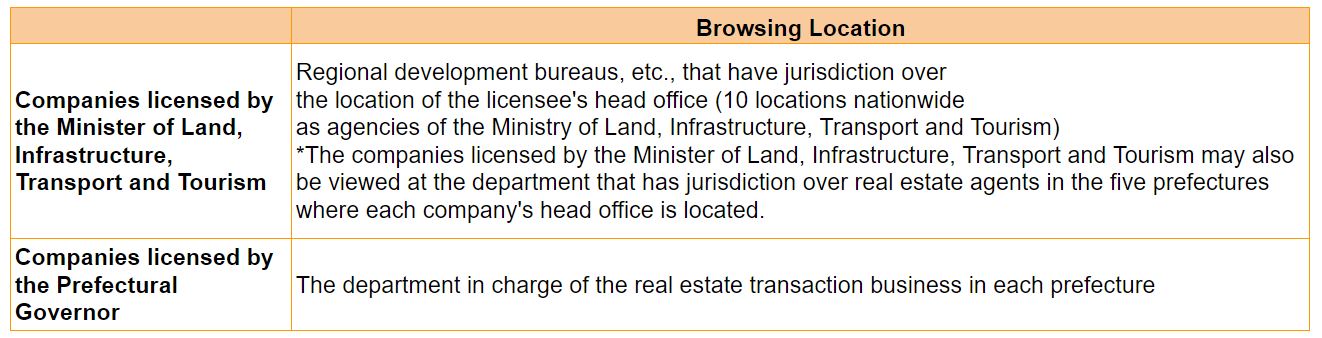 Documents available for browsing
Memberships in Trade Associations There are four trade associations in the real estate distribution industry. Each organization provides training, guidance, and business support to its member companies, as well as consultation on consumer complaints. It is advisable to check the membership status of real estate companies in the associations for reference. If a real estate company is a member of an industry organization, the membership is listed near the name of the real estate company in the real estate advertisement.  Column: Prevention of Malicious Solicitation by the Real Estate Industry As consumer protection is being strengthened, more and more people are seeking advice regarding malicious solicitation of condominiums. Therefore, the Ministry of Land, Infrastructure, Transport and Tourism has clearly stipulated prohibited acts in the Enforcement Regulations of the Real Estate Transaction Business Law. Specifically, the following acts are prohibited.
Buying a House: Finding a Home 6What is a house with a Housing Performance Evaluation Certificate? A "house with a housing performance evaluation certificate" is a house for which a third-party evaluation certificate on housing performance has been issued based on the "Housing Performance Indication System" stipulated in the Law Concerning the Promotion of Housing Quality Assurance, etc. It is important to know what kind of system it is and what kind of advantages it has.  Point 1: What is the Housing Performance Indication System? The Housing Performance Indication System for newly built houses was launched in 2000. Under this system, a registered housing performance evaluation agency, a third-party organization registered by the Minister of Land, Infrastructure, Transport and Tourism, evaluates housing performance in 33 items in 10 fields* (for newly built houses), including structural stability, mitigation of deterioration, consideration for maintenance and renewal, thermal environment, and energy consumption, on a scale of 1 to 5. This provides an objective performance evaluation of the house. This program is voluntary, and not all homes undergo performance evaluation. Note that anyone can request a housing performance evaluation, including the building company that built the house, the buyer of the house, or the seller of the house. Two types of residential performance evaluations for new homes There are two types of performance evaluations: Design Housing Performance Evaluation, which summarizes the evaluation results of the design documents, and Construction Housing Performance Evaluation, which is based on the results of on-site inspections and verification of construction record documents at the time of construction and completion for houses that have undergone Design Housing Performance Evaluation. Existing houses are also subject to the evaluation system In August 2002, the Performance Indication System for Existing (pre-owned) Houses was also launched. In the evaluation of existing houses, among the performance indication items for new houses, there are 28 items in 9 fields that can be evaluated with a certain level of reliability even for existing houses, and 2 items that are only for existing houses. While the evaluation of the deterioration status of the existing house is mandatory, the evaluation of the individual performance of the house is optional.  Point 2: Features of Housing with Housing Performance Evaluation Certificate A house with a Housing Performance Evaluation Certificate has many advantages.
 Point 3: Housing dispute resolution through the Housing Performance Indication System In the event of a housing dispute or a dispute between parties concerning a contract or sales agreement on a house for which a Construction Housing Performance Evaluation Certificate has been issued, you may apply for dispute resolution at a designated housing dispute resolution organization (local unit bar association) designated by the Minister of Land, Infrastructure, Transport and Tourism. The fee for dispute resolution is 10,000 yen per case. *A designated housing dispute resolution organization is an organization that facilitates and speeds up the resolution of housing disputes. Housing dispute resolution mechanism under the Housing Performance Indication System 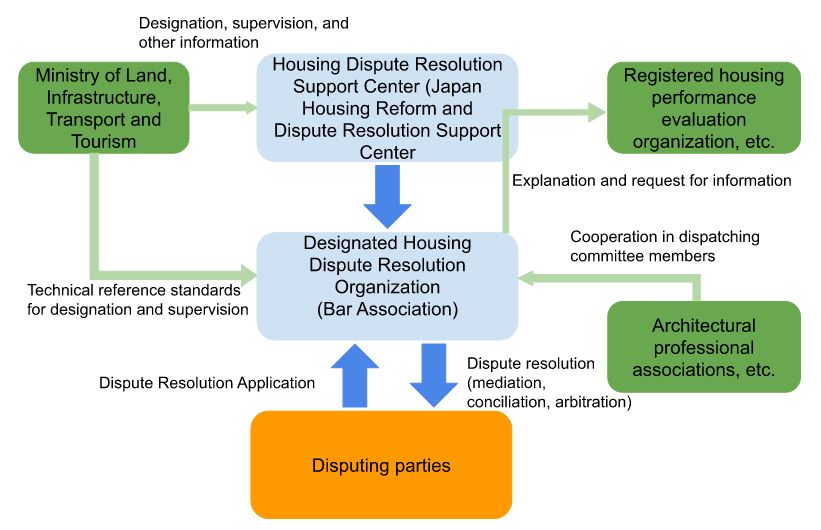 Buying a House: Finding a Home 5Points to check during a site visit If you find a property you like in a a real estate ad, visit the site and check in detail what you cannot know through the ad or other information available.  Point 1: Check the surrounding environment During a site visit, you need to thoroughly check the surrounding environment, including convenience and comfort. It is important to check with your own eyes not only the access to the station, availability of public facilities and convenience facilities, etc., but also whether there are any objectionable facilities or large vacant lots. If there is a large vacant lot, the environment may be completely changed by the construction of a large building. Signs may be posted to inform you of buildings that are to be constructed, so be sure to check these signs. When checking the surrounding environment, it is recommended to check the surrounding area with a map in advance to facilitate the confirmation process. It is also important to check the surrounding environment at different times of the day and on different days of the week. The atmosphere of the neighborhood may be different during the day and night, and on weekdays and holidays. Also, when it rains, you can see where rainwater flows in and where drainage is poor. If you buy a house, you will live there for a long time, so check carefully. The Great East Japan Earthquake has raised awareness of disasters such as flooding and liquefaction of the ground, as well as earthquake damage. Even if a building is sturdily constructed, lifelines may not be available due to soft ground in the surrounding area, so be sure to gather information on disaster prevention in the area you are considering purchasing. Check disaster prevention maps that predict damage from earthquakes, such as building collapse, liquefaction, and fires, as well as hazard maps for floods and tsunamis. Example of items to check in the surrounding environment Items to check for convenience
 Point 2: Checklist for a site visit (newly built properties) In the case of newly built properties, the points to check differ depending on whether it is an unfinished property or a completed property. In the case of a completed property, you can actually see the property, so check in detail the size, specifications, facilities, etc., as well as the view from the windows. If you are visiting a model room for an unfinished property, consider the differences in layout and size from the property you wish to purchase. In addition, many of the facilities are optional rather than standard specifications, so be sure to check them carefully. Examples of items to check during a site visit (newly-built properties) Building, floor plan and facilities (for both single-family homes and condominiums)
Common areas and management (for condominiums)
 Point 3: Checklist for a site visit (existing/pre-owned properties) For existing/preowned properties, in addition to the items to check for in a new property, you need to check the building's maintenance and facilities for damage. For single-family homes, look at the building's exterior walls, roof, building foundation and foundations, and for condominiums, look at the exterior walls and common hallways, and note whether there are any major cracks or tilts. If it is difficult to judge the condition by yourself and you are concerned, you can request a "home inspection" by a specialist such as an architect to check the deterioration of the house, whether there are any defects, and areas that need to be repaired. When touring a used property, please be aware that the seller may be living in the property, so please mind your manners. Also, if you notice any stains, scratches, or defects in the equipment or interior, you may need to consult with the real estate agent later. If you are purchasing a used property and remodeling it, check in advance whether you can remodel it as you wish. Mainly, for condominiums, it is necessary to check the restrictions on remodeling according to the "management agreement," and for single-family homes, it is necessary to check the restrictions according to laws and ordinances. In addition, there are cases where remodeling is difficult due to the structure of the building, so it is advisable to consult with a specialist or other professional to whom you will commission the remodeling project. Examples of items to check during a site visit (existing/pre-owned properties) Building, floor plan and facilities (for both single-family homes and condominiums)
Home Inspection
A home inspection (home inspection/building inspection) is an objective diagnosis of the presence or absence of defects, areas that need to be renovated, and the timing of such renovations, conducted by an architect or other specialist with expertise in home design and construction, who investigates the deterioration of the house. The content of the survey varies depending on the survey company and the client's intentions, ranging from visual inspections to the use of specialized survey equipment. Especially for existing homes that have been in use for some time since they were built, it is difficult for consumers to determine the deterioration of the structural parts of the home and the need for repairs, etc. Recently, more and more homes are being bought and sold after a home inspection is requested in advance. The Ministry of Land, Infrastructure, Transport and Tourism (MLIT) has formulated the "Existing Home Inspection Guidelines" to provide guidelines on inspection items, inspection methods, and procedures for inspecting the existing conditions. Buying a House: Finding a Home 4How to Read a Real Estate Advertisement: Property Section Real estate advertising is also regulated by property types. Take a look at some important points to consider when looking at advertisements for newly built properties for sale, used condominiums, and used single-family homes.  Point 1: Real estate checkpoints: new construction for sale It is important to confirm that the number of units for sale and prices are viewed differently for newly constructed properties for sale than for existing properties because, for example, several properties are sold at once in the same residential development area or condominium. 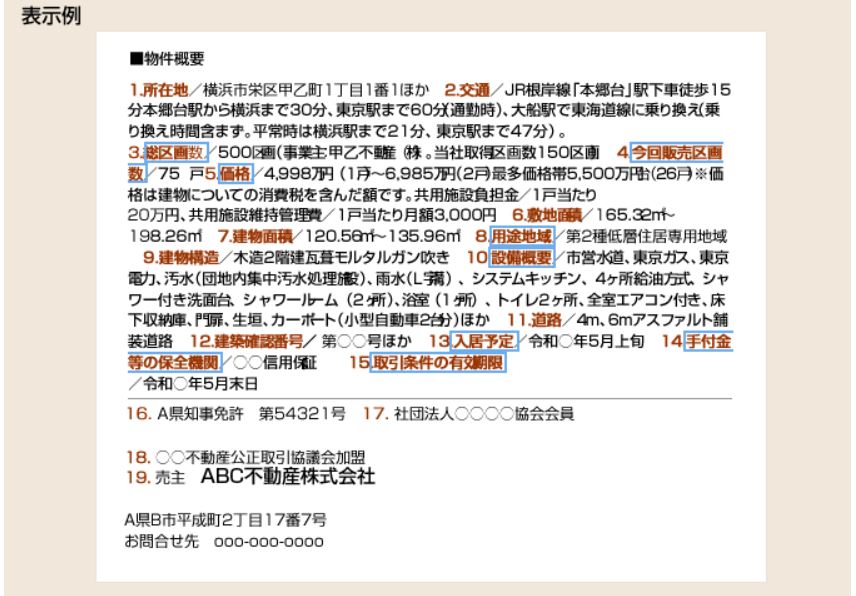 Display example: Property Overview 1. Location: 1-1-1 Ko-otsu-machi Sakae-ku, Yokohama 2. Transportation:
5. Prices: 49.98M JPY (x 1)ー69.85M JPY (x 2): 26 are in the price ranges of around 55.00 JPY *Prices include sales tax on buildings. Common facility contribution fee: ¥200,000 per unit Common facility maintenance fee: ¥3,000 per unit per month. 6. Land area: 165.32㎡ー198.26㎡ 7. Floor area: 120.56㎡ー135.96㎡ 8. Zoning: Type 2 low-rise residential zone 9. Building structure: 2-story wooden building with a tiled roof (mortar sprayed) 10. Facilities: city water supply, Tokyo Gas, Tokyo Electric Power Company, sewage (centralized sewage treatment facility in the complex), rainwater (L-shaped ditch), system kitchen, 4-position fueling system, shampoo vanity, shower room (2 locations), bathroom (1 location), 2 toilets, air conditioning in all rooms, under-floor storage, gate, hedge, roofed car garage (for 2 compact cars), etc. 11. Road: facing the 4 meter-wide asphalt paved road for 6 meters 12. Building Permit Number: No. OO 13. Scheduled move-in: Early May of Year 14. Deposit security institution: OO Credit Guarantor 15 . Expiration Date of Terms and Conditions: the end of May of Year 16. Licensed by the Governor of Prefecture A, No. 54321 17. Member of OOOO Association 18. Member of OO Real Estate Fair Trade Council 19. Seller: ABC Real Estate Co. 2-17-7 Heisei-cho B City, A Prefecture Phone* OOO-OOO-OOOO *This example is for general newspaper and magazine advertisements. Total Number of Lots and Number of Units to be Sold (Total Number of Units and Number of Units to be Sold) The total number of lots is the number of all lots in the area to be developed, and the total number of units is the number of houses/condominiums scheduled to be sold. In the case of large-scale subdivisions, sales are often staggered and divided into several phases, and the number of lots and units to be sold at this time indicates the number of lots and units that are to be sold at the time of advertisement. Price and Other Costs Prices must in principle be shown for all properties, but when a large number of properties are to be sold, the lowest, highest, and most expensive price ranges and the number of properties in those price ranges will be shown. The prices also include costs for water, sewerage facilities and city gas supply facilities. In addition, if there are other charges for common facilities or special facilities, and if there are maintenance and management fees for those facilities, the details and amounts of those fees will be displayed. Zoning (common to all properties) The zoning of the property location is displayed. The zoning district is a designation under the City Planning Act that restricts the buildings that can be built and their uses, and defines the use of land in each area. There are a total of 13 zoning districts, and the Building Standards Law defines restrictions on buildings that can be constructed, the building-to-land ratio, and the floor-area ratio for each of these zoning districts. Facilities Overview (common to all properties) An overview of facilities such as water and sewage facilities and gas is displayed. Anticipated Move-in Date and Construction Date In the case of a newly constructed property for sale, the expected move-in date will be listed if the building is not yet completed, and the construction date is listed if the building has been completed. Agency for the Preservation of Deposits, etc. When a real estate company (real estate transaction agent) acts as the seller itself and a deposit, etc. in excess of a certain amount (5% of the amount of the price or in excess of 10 million yen in the case of a purchase and sale before completion of construction, or 10% of the amount of the price or in excess of 10 million yen in the case of a purchase and sale after completion of construction) is paid at the time of the sales contract, the seller must take measures to preserve the deposit received. The measures to preserve the deposit, etc. may include a guarantee by a guarantee company, etc. or insurance by an insurance company, etc. This prevents the buyer from being unable to recover the deposit paid in the event of the seller's bankruptcy before delivery. The agency that implements the security measures can be confirmed in the advertisement. Expiration Date of Terms and Conditions In the case of newspaper inserts, etc., the expiration date of the terms and conditions is displayed. In the case of Internet, the information update date is displayed. Properties with good conditions tend to attract buyers quickly, so it is important to check the validity period of the terms and conditions as well as the date when the information is updated.  Point 2: Real estate checkpoints: used condominiums Although many used condominiums are undervalued in terms of property price, they may incur large repair costs due to the aging of the property. Here are some items to check that are unique to used condominiums. 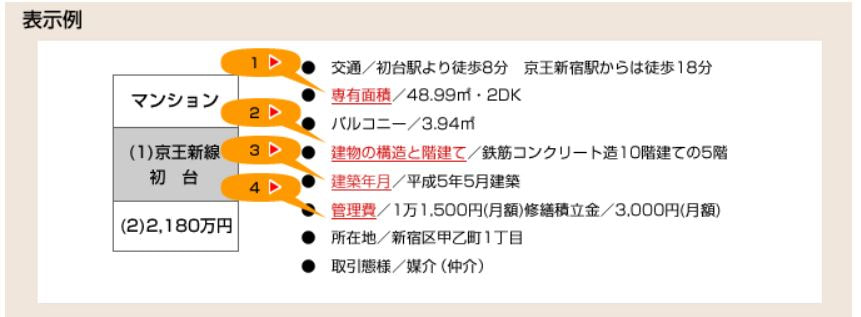 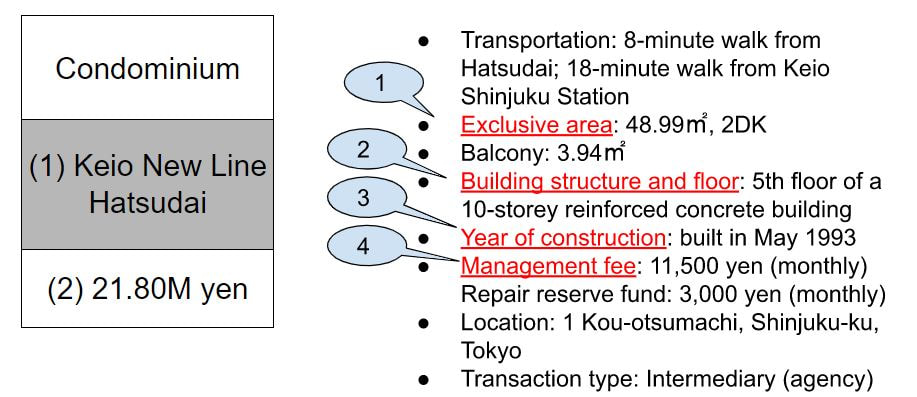 *These examples are for general newspaper and magazine advertisements. Examples of company name, building license number, name of organization, company address, etc. are omitted. 1. Exclusive Area This is the area of the portion owned by the buyer. In principle, the wall-core area measured from the center of the wall is indicated, but in the case of an existing condominium, the area may be indicated by the area of the registration record (registry) measured from the inside of the wall. Balconies are common areas, so their area is not included in the exclusive area. 2. Building Structure and Stories Indication of the building structure may be omitted. The phrase "5th floor of a 10-story building" indicates that the condominium building is 10 stories high and the house being sold is on the 5th floor. 3. Year and Month of Construction The year and month when the building was completed are indicated, rather than the year of construction. Even if the property has never been occupied, if more than one year has passed since construction, it is treated as a used property in real estate advertisements. 4. Management Fee (common to all condominiums) The monthly management fee and reserve for repairs are shown. In addition, there may be fees for parking, trunk room, and private garden. In addition, the management system may be displayed as "Resident" (when a janitor is stationed at the property), "Day shift (commuting)" (when a janitor is stationed only during the daytime), "Patrol" (when a janitor patrols multiple apartments), or "Self-management" (when no janitor is stationed at the property).  Point 3: Real estate checkpoints: used single-family homes Each and every existing single-family home has different characteristics. First, check to see if the size, floor plan, year of construction and location match your needs. 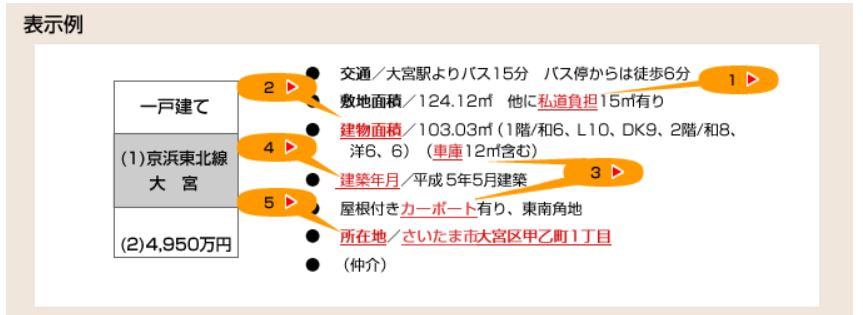 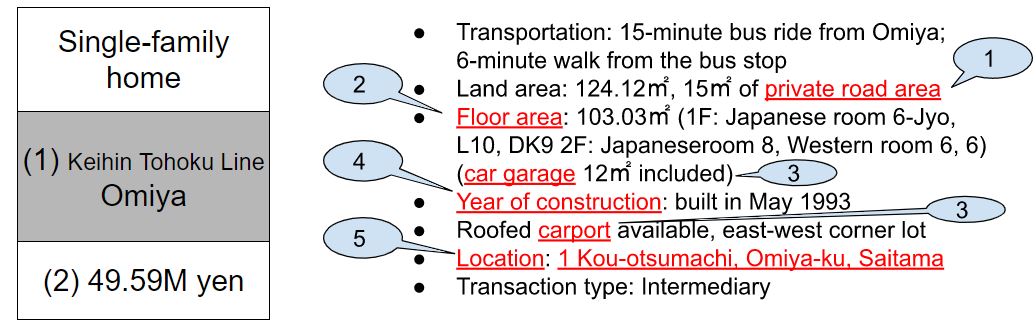 *These examples are for general newspaper and magazine advertisements. Examples of company name, building license number, name of organization, company address, etc. are omitted. 1. Private Road Area
When the land to be sold includes a private road, the area of the site and the area of the private road burden are indicated separately. If the private road portion is owned solely, the area is indicated as "private road burden 20㎡", etc. If the private road portion is shared with surrounding owners, the ratio of ownership is also indicated as "private road 100㎡, 1/5 of ownership". 2. Floor area of the building If the floor area of the building includes an underground garage or basement, a statement to that effect and the floor area is also shown. 3. Car Garage A "carport" is a simple parking facility with only a roof and posts. A building that can store cars and has a roof and walls can be labeled "with a garage. Otherwise, ambiguous indications such as "with a garage" or "cars allowed" are prohibited. 4. Year and Month of Construction The year and month when the building was completed are displayed, not the year of construction. Even if the property was expanded or remodeled after construction, the year of construction at the time of completion will be displayed. Even if the property has never been occupied, if more than one year has passed since construction, it will be treated as a used property in real estate advertisements. 5. Location It is permitted to omit the detailed lot number of the property location. In addition, the location shown in the advertisement is based on the registered lot number, not the residence indication number. Please note that in some areas the registered lot number and the residential indication are the same, but in others they are different. |
AuthorArrows International Realty Corp. Archives
June 2023
Categories
All
|
 RSS Feed