Can't borrow even if you have the income and ability to repay the loan? 4 Patterns that prevent you from getting a mortgage on an existing home purchaseRising land prices and building costs have caused the price of new properties to rise. As a result, used homes are attracting attention. Renovation properties", which renovated used homes to be more stylish and functional than new homes, have become popular, and the number of people considering the purchase of used homes is increasing. Incidentally, renovation is a type of reform, which means to renovate an existing home to have better performance than when it was new. Nowadays, there are mortgage loans that can be borrowed together with the cost of renovation, so if you are thinking of buying and renovating an existing house, if you do the renovation at the same time of purchase, you can borrow a mortgage to combine the cost of purchase and renovation of the house. Many people know that in order to take out a mortgage loan, you need to have a certain income and the ability to repay the loan. But did you know that there are cases where you can't get a mortgage even if you have the income and the ability to repay the loan? That's what we call an "Existing Home with No Mortgage Available". Why can't I get a mortgage?When financial institutions provide mortgage loans, they screen the "person" and "property". The "person" screening is based on the applicant's income, place of employment, and whether or not he or she has any other loans, and whether or not he or she will be able to repay the mortgage without delay. On the other hand, the screening for "property" is based on whether the property is worth lending money to. Mortgages are lent against the property (land or building) that the loan recipient is purchasing. Simply put, if the borrower is unable to repay the loan, the financial institution will sell the property and use the proceeds to repay the loan. However, in some cases, financial institutions do not recognize the value of the collateral and will not lend the mortgage even if the loan applicant's ability to repay the loan. A "financial institution does not recognize the value of the collateral" means that even if you try to sell it, a buyer cannot be found, or even if you can sell it, it was judged that you cannot collect the loan. If you consider a house to be an asset, you should not buy a property that you cannot get a mortgage loan for. So, what kind of property is such a mortgage loan not available?  <Case 1> Leasehold houses and houses with fixed term leasesA leasehold is simply "the right to rent someone else's land and build your own building on that land". A fixed term land lease is a tenancy for a fixed period of time (generally 50 years or more), and the principle is that after the term expires, the building is demolished and the land is cleared and returned to the owner. Although it is necessary to pay the deposit and the monthly ground rent at the time of a contract, since the land rent is not included, it seems to be a case where it can be purchased at about 40-50% of a general house. However, it can be difficult to get a mortgage loan because the ownership of the land does not belong to the person who bought it and financial institutions cannot use the land as collateral. Some financial institutions make it clear that they will not handle leasehold or fixed-term leasehold homes. However, it is common for new condominiums for sale to have an affiliated loan, so you can get a mortgage. <Case 2> Housing built in an urbanization control areaThe house can be built in the area that corresponds to the "urbanization area" defined by the city planning law. Although "the urbanization control area" has a name similar to this, it is the area where urbanization must be controlled, that is, urbanization must be suppressed, and a general house cannot be built in principle. In fact, some people have built their houses and are living in them even before they were set up in the urbanization control area. The house built in those urbanization control areas can be purchased, but the borrowing of the mortgage becomes difficult. In addition, the relief measure "the existing housing site" which permits building exceptionally, such as the person who lived before it is set up in an urbanization control area, also exists. <Case 3> Reserved land for land readjustment projectsLand readjustment projects are "projects to improve public facilities such as roads, parks and rivers, and to demarcate land in order to improve the use of residential land. In some cases, land owners have to bear the costs of land readjustment projects, but in such cases, the land owners do not bear the costs in monetary terms, but rather the land owners within the area gradually pool their land to establish a reservation, which is then disposed of and used to cover the project costs. Some financial institutions do not offer mortgages for the purchase of this reservation land for the land rezoning project. However, some financial institutions do sell "reservation loans" specifically for reservation land, so please consult with your financial institution on an individual basis. <Case 4> Property that cannot be reconstructedA property that is designated as non-reconstructable cannot be "rebuilt". There are several reasons for being designated as non-reconstructable, but the most common is a case of violating the "duty of access". So, what is the duty of accessibility? The Building Standards Act basically dictates that the land on which a construction site is to be built must abut a road that is at least 4 meters wide and at least 2 meters long. When this regulation is established, the building that has already been built cannot be demolished because "it is in violation", so the building remains as it is, but "rebuilding" is not allowed, which is a property that cannot be rebuilt. If the streets are narrow, the possibility of the fire spreading increases, so it is also meant to strengthen the fire prevention system. In some old streets, buildings are crowded at both ends of narrow streets, or houses are built in alleys and corridors from the street. The above are the main, when buying real estate, the mortgage is not available, and even if it is available, the collateral valuation is low.
When buying the real estate which exists in these cases, there are cases where the method of payment is limited to cash. Let's confirm whether it does not fall under the above beforehand, and try to make a smooth transaction. 8/20/2020 the Inns and Hotels Act, the National Strategic Special Zones Act, and the Private Lodging Business ActRead Now What is "Private Lodging"?Following yesterday, we will explain about Private Lodging in Japan. Below is a comparison table, so please check what is different according to each act. Although "Private Lodging" is not defined clearly in the laws and regulations, it refers to the provision of accommodation service to travelers and other users by utilizing all or part of housing (condominiums, including detached housing and apartments) is generally called "Private Lodging." In recent years, there has been a rapid development of businesses matching those who want to lend a vacant room for a short period via the Internet with those who hope to find accommodation. Expectations for Private Lodging are also rising in Japan as well, from the viewpoint of community activation, such as responding to the various lodging needs of the rapidly increasing numbers of international visitors to Japan, and effectively utilizing the increasing number of vacant houses due to an aging society with fewer children. On the other hand, since there are people conducting Private Lodging without approval, though they fall under the hotel business that requires approval under the Inns and Hotels Act, it is necessary to handle these situations by setting rules, giving consideration to the securement of public health, such as to prevent the spread of infectious diseases, and to prevent trouble with community residents. Based on these issues, the Private Lodging Business Act (Act No. 65 of 2017) has become effective in June 2017 for disseminating proper Private Lodging services under certain rules. Starting with the enforcement of the Private Lodging Business Act from June 2018, those who conduct Private Lodging in Japan need to select a method from the following. 1.Obtain permission in respect to the Inns and Hotels Act (Act No. 138 of 1948) 2.Obtain authorization in respect to the National Strategic Special Zones Act (Act No. 107 of 2013) (Special Zone Private Lodging) 3.Register in respect to the Private Lodging Business Act Comparison of the overview on these systems is as follows.
 Inns and Hotels ActThe Inns and Hotels Act is a law set forth for the purpose of contributing to improve public health and people's lives through promoting the provision of services that cope with enhancement and diversification of the user's demands in the hotel business field, while planning to develop sound hotel businesses by securing appropriate operation in the hotel business. The Hotel Business is defined as "a business that lodges a person for a fee" and "lodging" is stipulated as "to use a facility by using bedding" in this law. In order to operate this hotel business, it is stipulated that obtaining permission in accordance with the Inns and Hotels Act is required. In addition,the hotel business differs from the room renting business, including apartments, concerning the following points. (1) Responsibility on maintaining and managing the cleanliness of the facility, including the rooms for lodgers, is universally accepted to be on the operator, considering from point of facility management and operation form in general, and (2) the room of the facility that the lodger uses is not the principal place of residence for that person. Even if housing are used for lodging, obtaining permission in accordance with the Inns and Hotels Act is required, since conducting a "Private Lodging Business" that provides lodging repeatedly for a fee basically falls under the hotel business. There are several types of permission in accordance with the Inns and Hotels Act, however, obtaining permission for operating simple lodging is common if conducting a private lodging business without registration. (Hotel Business Classification) 1. Hotel Operation (*) Operation, where a facility mainly consisting of western style structure and equipment is established, and accommodates it to a person for a fee. 2. Inn Operation (*) Operation, where a facility mainly consisting of Japanese style structure and equipment is established, and accommodates it to a person for a fee. 3. Common Lodging House Operation Operation, where a facility consisting of structure and equipment is established for several persons to share, and accommodates it to a person for a fee. (pension, youth hotel, etc.) 4. Boarding House Operation Operation, where a facility is established, and accommodates it to a person for a fee on a monthly basis. (*) Hotel operation and inn operation will be integrated as "inn and hotel operation" from June 15, 2018 as "operation, where a facility is established, and accommodates it to a person for a fee excluding simple lodging operation and boarding house operation". The structure equipment of the facility to be used needs to meet the standard upon obtaining permission. In addition, application to the prefectural (including the city that establishes a health center and special zone) health center, where the facility (housing) expected to conduct the Private Lodging service is located, is required. Permission standard for simple lodging (standard on minimum floor area) was relieved in April, 2016 and obtaining its permission has become easier than before.  Cases Not Applicable to the Inns and Hotels ActThere are some cases that do not apply to the Inns and Hotels Act, even if they are providing lodging services using housing. Some examples are as follows.
■In case of providing one's house in accordance with a local government's request when an event is held (Government Notification in July 2015) ⇒ To solve the shortage of lodging facilities in an area, when lodging facilities run short for an event that is expected to attract many customers, event-private-lodging enables travelers to stay in facilities which are originally not lodging facilities. The event-private-lodging is expected to be effective from the viewpoint of local creation through tourism, as it leads to promoting interaction between the people of the area and travelers, as well as expanding tourism consumption in the area. ■Short-term residence to vacant house properties with the purpose of buying and selling or leasing to a person wishing to move (Government Notification in March 2016) The Inns and Hotels Act will not apply to a short-term residence to a vacant house property from the assumption that it will be bought, sold or leased to a person wishing to move, if all of the following measures are taken. (1) The activity of using and utilizing the vacant property is placed in accordance with the Act on Special Measures on Promoting Countermeasures on Vacant Houses, etc. (Act No. 127 of 2014), and the subject of the facility is specified in a local public entity, such as when the local public entity that is to conduct such activity has registered the vacant property. (2) A person who is to purchase or lease the subject of the facility can be confirmed by the local public entity that such person truly has the will to purchase or lease such facility for long term. (3) It can be confirmed that the actual condition of the facility is secured from many and unspecified persons using it repeatedly and continuously, through taking the measures written in (1) and (2). ■In cases where a regional council and other entities commissioned from a local public entity does not receive value equivalent to the lodging fee from the lodger, but only receives value equivalent to counseling related to such hands-on experience (Government Notification in March 2016) In a case where a regional council or other entities commissioned from a local public entity does not receive value equivalent to lodging fee from the lodger, but only receives value equivalent to guidance related to hands-on experiences, expenses paid by a regional council or other entities to farmers and other persons that provide hands-on experience services for educational trips that are accompanied by hands-on experiences does not come under the Inns and Hotels Act, as such fees do not apply to lodging fees. Please contact your nearest health center to ask whether any matter comes under the Inns and Hotels Act. https://www.mlit.go.jp/kankocho/minpaku/overview/minpaku/law2_en.html Is real estate management properly done?When managing real estate, it is necessary to confirm that the rent has been properly paid. Many lessees pay rent by the deadline, but some of them leave it until reminder. Even in the real estate managed by our company, one or two properties are delinquent every month, and we notify the lessee at the beginning of the month. Normally, when they receive the reminder, lessees will be paid the rent within a few days. However, there are cases where payment is not made until waiting for half a month, so the competence of the management company is questioned. If there is a guarantor company, we will remind them via the guarantor company. In some cases, it may be more effective for lessees to reminder through the property management company than to contact the landlord or management company.  As a method to prevent rent delinquency, if there is even one delinquency, it is necessary to check the payment frequently from the next time and create an environment where the reminder is notified without delay when the next delinquency occurs. If the rent still get delinquency often, or if we think lessee isn't capable for the payment, we'll ask their joint guarantor to ask the rent payment instead of lessee. After three months of delinquency, we will proceed with the story of leaving. Under Japan's Leased Land and House Lease Law, it is not possible to cancel a lease contract by simply not paying the rent, but we can start the procedure. We will notify lessee by registered mail and explore the direction of exit from all angles. Leasing is based on an agreement between the lessor and the lessee, and payment of rent is the fulfillment of the contract. The management company manages properly, receives rent, manages the building, and manages the tenants appropriately. Let's eliminate arrears in rent with proper management.
Business starts on Monday after ObonMany companies are starting operations today. Depending on the real estate company, some companies are open from 16th, and some are closed until 19th, but we are restarting from today. Since REINS, which shares information among traders, will be stopped online from 14th to 17th, new registration and renewal work will be possible tomorrow. We use this system to obtain and confirm information that our company does not have, so we will confirm the property from tomorrow morning and will contact the customers who are waiting for us. It is customary to go home during the Obon season, but the news shows that the Shinkansen occupancy rate was low across the board. It is famous every year such as U-turn rush, and it was crowded everywhere, but it seems that there were very few people coming and going this year. Two weeks after the Obon season, the end of August, how much more people will be infected with coronavirus at this time is likely to be the point later this year. The new school year will resume in one week at the earliest schools, so it seems that it is necessary to pay attention to the trends over the next 1-2 weeks.  I work in Kyoto, but I live in Shiga Prefecture. In the summer, we can enjoy swimming and camping at Lake Biwa, as well as BBQs in the mountains and rivers. There is plenty of nature to spend time with the children, and it is a very nice environment. Right now, there are restrictions on movement, but next time you're in Kyoto, we hope you'll stop by Shiga Prefecture as well.
You can still do DIY in a Rental. What is the Key to Actually Doing DIY?DIY stands for "Do It Yourself," which means to make your own furniture and decorations. DIY is popular among women as well as men because it allows you to change a room into a space of your choice on a low budget, but many people may have the image that DIY is difficult to do in a rental house. However, with a little ingenuity, it is possible to do DIY in a rental property. In this article, we will introduce in detail the points to keep in mind when doing a do-it-yourself project in a rental house, and actual DIY examples, with explanations. You can DIY in a rental house.It is possible to enjoy DIY in a rental home with some creativity. For example, if the furniture is already in use, it belongs to you, so you can do whatever you want with it without damaging the room. Just remaking the furniture you have on hand can change the atmosphere of the room, and one of the appealing aspects of DIY is that you can change it to make it more user-friendly for you. If you want to change the wallpaper, there are easy to use wall stickers that you can put up and peel off, easy to try out such as masking tape, or even peel-off wallpaper that can be used on the entire wall. There are also wallpaper sheets that can be painted over. These products can be restored to their original state without damaging the wallpaper when they are removed, so they can be used in a rental house without any worries. In addition, if you have an inset floor mat, it has an absorbent backing and can change the look of your floor simply by placing it without the use of glue. Cushioned floor mats are convenient for protecting the floor at the same time. They come in a variety of patterns and materials and can be changed to suit your taste and mood. In addition, there are also tile sheets that can be used around the water, glass film for windows, and many other products on the market depending on the purpose and location. What to Look for When Doing a DIY Project in a Rental HouseThere are a few things to keep in mind when it comes to actually doing a DIY project. The first thing you want to pay attention to in order to do a DIY project in a rental house is that the work should be done to the extent that it can be restored to its original condition. Restoration means that the property must be returned to its original condition when you move out. If you damage a wall or floor in the process of DIY, you may have to pay for the repair, so please be careful. It is also important to abide by the management rules of the apartment or condominium and carry out the work. Be sure to check with your landlord before doing any DIY work, including the matter of restoration of the original condition. During DIY construction, you may end up causing problems for neighbors with noise and other disturbances. If you are in a housing complex, one way to avoid this problem is to use a material cutting service at a home improvement center or a workshop for buyers. You can also rent tools and equipment here, and you can work without worrying about dust and noise. If you work at home, make sure you do it at a sensible time.  DIY PracticeSo what are some of the actual DIY's you can do in your rental home? Here are a few examples to get you started. Wall Redecoration If you want to make a big change in the atmosphere of a room, you can redecorate the walls. If you don't use strong adhesives, you can redecorate your walls without damaging them. As we touched on a little earlier, decorating your walls with peel-off wall stickers or masking tape is an easy way to redecorate. There are many different types of stickers available for use on a point instead of the whole wall, so you can make a big difference in the impression you make. If you want to redecorate an entire wall, use peel-off wallpaper. It can change the entire wall, which can significantly change the atmosphere of the room. If you want to apply paint directly, you can achieve this by using peel-off wallpaper sheets for paint. Other popular options are to put up styrofoam walling like bricks or to install thin boards as temporary walls to create your own arrangement. Floor and Balcony One of the most popular floor redecorating solutions is a built-in floor mat. There are many different types of floor mats available, including flooring mats and carpet mats, which you can easily redecorate simply by placing them on the floor. Many of them have a non-slip surface on the back of the floor mat, which prevents them from sliding around in your daily life and is easy to remove. Some of those floor mats are washable, so they are clean and easy to use. Another type of floor mat is the sheet type, which can be cut into any size and placed on the floor without any gaps. There are also balcony floor coverings that can be placed on balconies for easy redecoration. There are many different types of floor coverings available, with natural wood and artificial grass being the most popular. There are also fences that you can simply assemble, and some of them can be used to decorate with pots for gardening and other purposes. Kitchen The kitchen area is a popular DIY project, especially when it comes to efficiency and functionality. When doing a DIY project, be sure to plan ahead to improve the usability of your kitchen. You can also use propped-up shelves or propping rods to provide more storage or a workbench. Water-resistant, peel-off stickers and wallpaper are great for redecorating kitchen walls and shelves. Not only do they change the look and feel of your kitchen, but they also prevent grease splatters and stains from sticking to your walls. Rental properties for DIY With more and more people doing DIY, a new type of rental property called a do-it-yourself lease has begun to emerge. These properties are based on the premise that the tenant is free to do their own DIY, and in exchange for the tenant paying for the work, the rent is cheaper than usual, among other advantages. Whether the work is done by a contractor or by the tenant themselves, you can rent the property without any problems. This is a great option for those who want to do some serious DIY work without having to worry about damaging the walls and floors. Choose a property that matches your level of DIY. It is possible to do some DIY in a rental property with some creativity, but it has to be done within a set scope. If you want to make a big change in the image of a room or if you want to try a real DIY project, you have the option of choosing a DIY-ready property. To get the home of your dreams, you can choose a property that suits your level of motivation and DIY skills. With more of these properties on the market, there are more options for investment properties from the investor's side. For example, it is possible to keep costs down on the side of investors by renting out properties on a do-it-yourself basis with minimal infrastructure such as water, electricity, gas, and leaks necessary for life, and other repairs and replacements. It is no longer necessary to rent out the property in a clean condition, and at rents slightly lower than the market rate, you can invest in real estate with a large investment cost down. This type of investment should be quoted separately from the investment to be made to rent out as a regular rental and as a minimum investment for a do-it-yourself property. If you are interested in this type of investment, please contact us for more information.
What are the Advantages and Considerations of a Single-story House? What kind of Family is it Suitable for?With the advent of an aging society, single-story houses that create a flat space with no steps are gaining attention. This section introduces the features of single-story houses, which are not often seen in urban areas, as well as the advantages and points to keep in mind. A Single-story House is a One-story HouseA single-story house is a one-story house. If you live in a major metropolitan area such as Tokyo, most single-family homes are two or three stories high, and there are few opportunities to see a single-story house. On the other hand, in Karuizawa and other vacation home areas, you can often see single-story houses. A one-story house creates beautiful scenery in harmony with the surrounding forests and woods. Single-story houses are often built on large lots, not only in vacation home sites. The reason is that in order to get the same number of rooms and living space as a two- or three-storey house, a single-storey house requires a large lot size. The Advantage of a Single-story Home is that the Floor is Flat.Next, let's take a look at some of the features and advantages of a single-story home. The advantage of a single-story house is that it is a flat house with no upper and lower floor movement, making it easy to move around the residence. The absence of steps in the house makes it easier for the elderly with limited mobility and children to live comfortably. For example, even if you are in a wheelchair, you can make your life easier by widening the corridor and making other planning adjustments. Another feature of a single-story house is good ventilation. Since there is no vertical movement of air, air circulation is easy if openings are made in all four directions. In addition, because there is no second floor, the building is structurally strong and is superior in terms of disaster prevention in the event of earthquakes and typhoons. Furthermore, repairs to the exterior walls and roof are easier to perform than in a two- or three-story building, and one of the features of a single-story house is that it is easy to maintain. 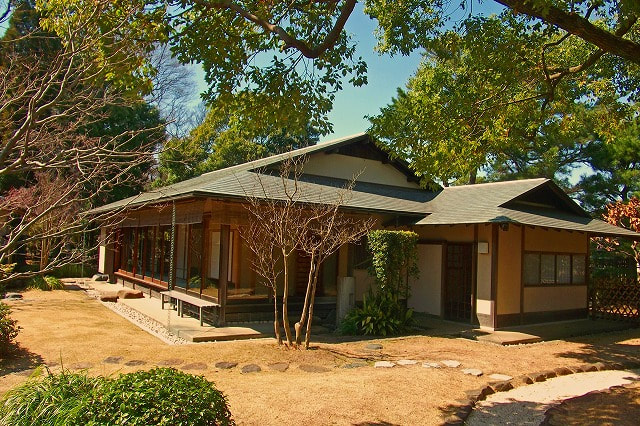 Location is Important for Single-story Homes. Suitable for Three Generations Living TogetherOne thing to keep in mind about single-story homes is that, as mentioned earlier, the size of the lot is necessary and the comfort of living in the location depends on the surrounding environment of the location. Since the building is only built on the first floor, it is important that there is space around the building and that it is in a location where there are no tall buildings around it to get light from the windows. It can be said that a residential area such as a first-class low-rise residential zone is suitable for a single-story house. Also, it is possible to take in the light by planning such as providing a courtyard. Since there are no stairs, you can reduce the dead space and increase the storage space. Also, since the structure is simple, it will be easy to remodel in the future. Easy to Live in for Seniors and Children, and Suitable for Three Families to Live Together.Having the family living on the same floor also makes it easier to communicate with them, as they feel close to each other. Because the house is child and elderly-friendly, it is also recommended for large families, such as three-generation families. Flat lines of flow are not only easy to live with, but also encourage interaction and communication across generations. From this point of view, it is a sustainable home that is easy to live in for the long term.
What is Obon in JapanWhat is Obon? If you were asked, what would you say? Although you may have heard about the day of your ancestors' return, you may not be aware that the date of the festival differs depending on the region where you live, or you may not be aware of the words "Shin-Bon" and "Hatsu-Bon," or the events that were born out of this festival. Obon, officially called "Ura-bon-e", is the period of time when the spirits of the deceased are brought back to this world (this world) from the Pure Land called the other world. During the Obon period, the spirits of the deceased family members and ancestors are welcomed and offered to the deceased. When does Obon start and end?The Obon period is generally considered to be four days, August 13th to 16th. In 2020, it will be Thursday, August 13th to Sunday, August 16th. The 10th August (Monday) is a national holiday, so if you can take the break on the 11th and 12th, you will have 9 consecutive holidays. In the past, the Obon holidays were from July 13th to 16th in the lunar calendar. In the new calendar, it is from the middle of August to the beginning of September. The origin of Obon is not well known, but there seems to have been a tradition in Japan since ancient times to make offerings to our ancestors in midsummer. It is thought that the Buddhist event called "Ura-bon-e", which takes place on the 13th to 16th of July in the lunar calendar, was introduced to Japan, and gradually became one of the most popular events in Japan. In 1873 (Meiji 6), Japan adopted the new calendar, and in many areas, the event was moved back by exactly one month (i.e., delayed by a month) to be held around August 15 for ease of understanding. This Obon is sometimes called "Kyuubon" or "Old Obon" because it is so close to the former lunar calendar.  What do you do on Obon?There are many different Obon traditions depending on the region. ● 1st The first day of the month of July or August is called "Kamabutaitachi", which is the day when the lid of the cauldron of hell is opened. This is the day when the cauldron of hell is opened, we will prepare for the following. - Cleaning the graves and visiting the graves. - Cleaning of Buddhist altars - Preparing a tray of lanterns, etc. ●13th In the evening, we light a "welcoming fire" to welcome our ancestors. The fire is made in the hope that our ancestors will not get lost.... ●14th and 15th It is believed that your ancestors will stay in the spirit cabinet during the Bon Festival. Make an offering of fruits, sweetmeats and food. ● 16th The ancestors are said to stay at home until the morning, so we make an offering in the morning. In the evening, when it gets dark, we make a "sending-off fire" and send them off. However, in reality, most people don't have the ability to make a fire. In modern times, electric tron lanterns are often used. When are you going to clean up the trays?After the send-off fire is over, we clean up that day, which would be the evening of the 16th. In some cases, you may have the send-off fire until late on the last night, in which case you will clean up the next day. What are some of the Obon events?The events and customs of Obon vary from region to region. Some of the unique events that have been nurtured in each region are still very much alive as a local tradition. Here are some examples. Gozan Okuribi On August 16, a fire is sent off on five mountains surrounding Kyoto: Higashiyama Nyoigatake, Matsugasaki Nishiyama and Higashiyama, Nishigamo Funayama, Daihokuyama, and Mandala Mountain. It is a traditional event to send the spirits of the Obon festival called "Shorai", also called "Daimonji". Shoronagashi This is a traditional event held in Nagasaki Prefecture on August 15 every year to send the spirits of the deceased off to paradise. The spirits of the deceased are paraded through the city on the occasion of the New Festival (Hatsu-Bon) on a large wheeled spirit boat, instead of being floated down the river.This is a very loud event, with bells set off and firecrackers set off in large quantities as they shout "doi, doi! This is the tradition of welcoming your ancestors and spending time with your family during the Obon period. This year, we have seen cases of people not being able to return home and being separated from each other, but let's pray that next year we will be able to spend time with our ancestors and their families.
What should be notified to tenants after purchasing a property under lease?In purchasing real estate, you may purchase real estate that is already leased as an investment property. The real estate purchase and sale is called sales with the burden of a lease, and an existing lease contract is taken over as it is. In the explanation of important matters received when real estate is purchased, it becomes "exclusive use by a third party - yes" and "relation of right - tenant (lease)". Here, after purchasing real estate, we will explain what kind of notice is made to a tenant. What is the purpose of the notice?First, the purpose of notifying the lessee of a change of ownership is to notify the lessee of a change of title and a change in the person to whom rent is to be paid. The lease is a contract between the original lessor and the current lessee. Therefore, a notice is required that the new owner has succeeded to the lessor's position. Normally, it is sufficient to make a notice of the change of lessor signed and sealed by all three parties, without making a new lease contract again. Also, when the owner changes, the account to which rent is to be paid will change. The lessee pays monthly rent to the lessor, but if the management company is the same as the existing company, the rent will be paid to the same company. In many cases, the management company will also change and will notify the tenant of the change in the account to which rent is to be paid. 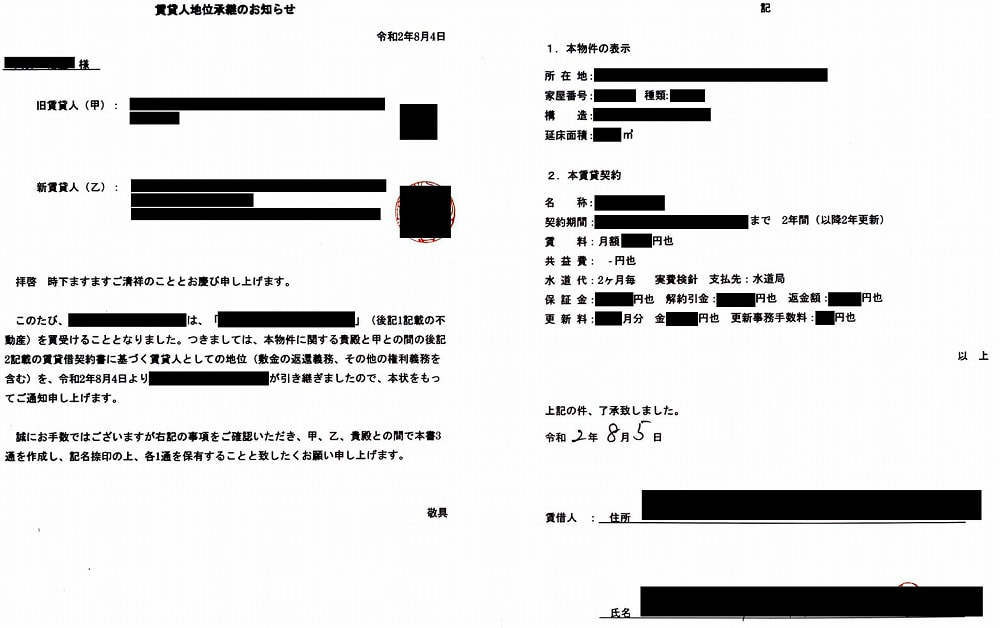 To prepare a notice signed and sealed by the new lessor and the old lessor.The lessee is notified of the change of ownership immediately after the property transaction is completed. The notice of change should be stamped by both the old lessor and the new lessor, and the lessee should be notified. If you receive a notice from another party pretending to be the lessor, it may be a fraud. The management company or lessor will contact the lessee in advance. Giving legitimate notice after the transaction is complete is the safest way to eliminate the tenant's concerns. In the notice of change, we will prepare an informational letter with the address, name and seal of the old and new lessor, the date of the assignment of rights, and a statement that we would like the lessee to sign and seal the lease. The letter will include an indication of the subject property and a description of the terms of the lease agreement. By indicating the real estate, you can confirm that the real estate to be notified is correct. In addition, it can be confirmed whether there is a difference in the interpretation of both parties by stating the terms and conditions of the lease contract that we had a copy of beforehand. In this way, trouble later on can be avoided. It is the following details. Real Estate Indications - Location - Housing number - Structure - Total floor area The Lease Agreement - Property Name - Contract Period - Rent - Common Service Fee - Water payment - Security Deposit, Deposit / Deduction amount and Refund - Contract Renewal fees, Renewal procedures fees, etc. The trouble at the time of the contract renewal and the leaving can be prevented by having the above contents described and the tenant confirm it. Since it leads to the trouble afterwards if these small points are neglected, let's prepare the document firmly at the time of a real estate transaction. Once the real estate transaction is complete, notify the tenant as soon as possible and have them sign and seal the confirmation. Be sure to date these documents so that you can look back and check them later when you need to confirm them. If you use a guarantor company, the procedure of the change of the lessor is carried out to the guarantor company, too. Check the necessary documents in advance and be prepared to get the old lessor's signature at the completion of the transaction. These procedures are designed to avoid problems later on, in order to buy an investment property and definitely get the rent. If you are considering the purchase of investment property, please contact us for more information.
Summary of Buy Land and Build a Custom HomeThis time, we've divided it into 4 days, and it's a summary page of how to buy land and build a custom house. We have listed the flow up to move-in, so please check the contents of each chapter and check them in order. ■Flow of Steps to Move In
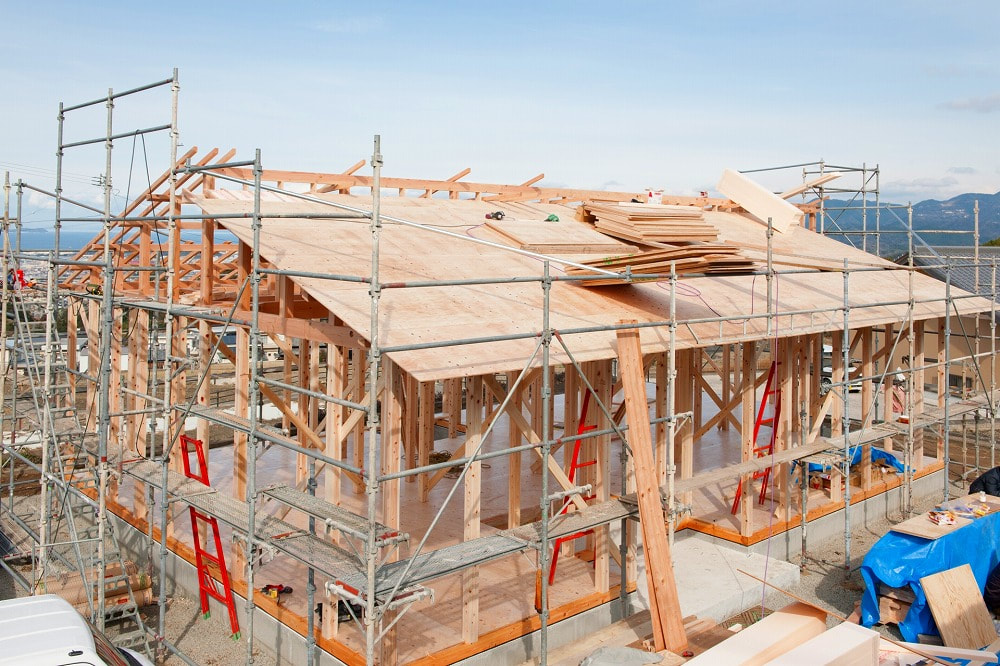
When you actually search for land and then a construction company, there are many unclear points. If you have any questions, please feel free to contact us. Let's build a dream home together.
|
AuthorArrows International Realty Corp. Archives
June 2023
Categories
All
|
 RSS Feed