Arrows International Realty
  • Home
  • Study
    • Rights of Property >
      • Real Right and Credit
      • Rights to the land and Rights to the building
    • the Building Lots and Buildings Transaction Business Act >
      • Laws Related to Real Estate Transaction in Japan
      • (1) Laws Concerning Land Use
      • (2) Laws Concerning Construction of Buildings
      • (3) Laws Regulating Real Estate Companies
      • (4) Laws and Regulations Concerning Advertisement
      • (5) Laws Concerning Contracts Including Sales Contracts and Lease Contracts
      • (6) Laws concerning Titles and Rights
      • (7) Laws Concerning Real Property Registration
      • (8) Laws Concerning Condominium Management
      • (9) Laws Concerning Defects (Faults, etc.) of Housing Properties
    • How to and Procedures >
      • Process of Real Estate Sale
      • Process of Real Estate Purchase >
        • the Process of Buying a House
        • Housing Prices
        • the Living Environment
        • the Budget
        • Find a Home
        • Choosing a Real Estate Agency
        • Financial Planning and Mortgage
        • Making the Final Decision to Purchase
        • Concluding a Sales Contract
        • Delivery of the Property
      • Cost by Transaction
      • Important Points Explanation
      • Real Estate Sales Contract
      • Property Condition Confirmation
      • Facilities and Equipment List
    • Building Management >
      • Process of Residential Property Management
      • Process of Real Estate Leasing >
        • Idea of Lease Agreement
      • Process of Second House Management
    • Related Acts
    • Glossary >
      • Real Estate Glossary in Japan
    • Tax in Japan >
      • Consumption Tax
      • Property Tax
      • Capital Gain Tax
      • Withholding Tax
      • Taxes on Gifts and Inheritances
    • Q&A >
      • Q&A
  • Local
    • Learning
  • Latest Information
    • Latest News
    • We Love Kyoto
  • Column
  • About Us
    • Records
    • Partners
    • Cookie Notice
    • Sitemap
  • Contact

10/2/2021

Outer Wall Setback, Daylight Regulations, Area Usage and Regional Planning

Read Now
 

6 Outer Wall Setback (Building Standards Act: ​Article 54)

In the 1st and 2nd class low-rise residential areas, the distance from the exterior wall of the building to the property line ("exterior wall setback distance") may be set at 1.5m or 1m by city planning.

7 Daylight Regulations (Building Standards Act: ​Article 56-2)

(1) Buildings located in areas designated by local government ordinances shall not create shaded areas within a certain distance from the property line for more than a specified period of time (2 to 5 hours) between 8:00 a.m. and 4:00 p.m. on the winter solstice.
(2) The shaded area is calculated at the height specified by the local government (1.5m, 4m, or 6.5m).
(3) Restricted buildings are those exceeding 7 m in eaves height or 3 or more stories above ground in the 1st and 2nd low-rise residential areas, and those exceeding 10 m in height in other areas. ​In areas with no zoning designation, the local government will assign one or the other.
(4) ​When shading occurs over areas with different restrictions, each of the restrictions for each area where shading occurs must be met.
  • ​Even if the building is outside the area designated by the ordinance, the restriction is determined by the area where the shading occurs.

8 Restrictions on Use by Zoning District ​(Building Standards Act: ​Article 48 Table 2)

(1) There are three types of city planning areas: urbanized areas, urbanization control areas, and areas without zoning. In these areas, 12 different zoning districts may be defined. ​Each zoning district or area without this designation defines the uses of buildings that can (or cannot) be built.
(2) ​In principle, no buildings can be built in the urbanization control area. ​However, there are some exceptions to this rule, such as when development permission based on the City Planning Law is obtained.
(3) ​If the property is located in more than one zoning district, the restrictions of the district to which the majority of the land area belongs will be applied.

9 Restrictions due to Regional Zoning, etc. (Building Standards Act: ​Article 68-2 and 70)

(1) ​For 2-6 and 8, please note that in areas such as district plans determined based on the City Planning Law, restrictions may be added by ordinance according to the characteristics of the area.
(2) Some areas have agreements (building agreements) regarding standards for the building site, location, structure, use, form, design, or building equipment.

Share

10/1/2021

Minimum Land Area & Height Limit

Read Now
 

Minimum Land Area (Building Standards Act: Article 53-2)

If the city plan stipulates a minimum land area for a building, no building can be built unless the area exceeds that limit. ​However, this does not apply to land areas that were below the minimum before the restriction was imposed.

Height Limit

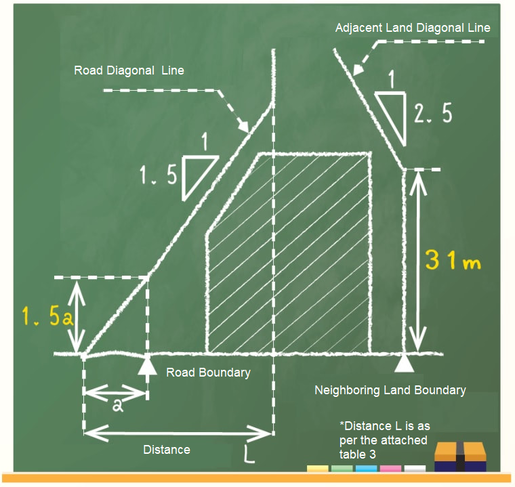
5-1 Diagonal Line Restriction ​(Road, adjacent land, north side) (Article 56 of the Building Standards Act)
Specific restrictions are determined by the site's zoning and designated floor area ratio. There may be mitigation measures depending on the setback distance from the boundary line, the difference in elevation, and the surroundings (park, river, railroad tracks, etc.).
(1) Road Diagonal Restrictions
If the property borders a road (there is a road boundary line), the height will be restricted according to the distance from the boundary line on the other side of the road.
(2) Adjacent Land Diagonal Restrictions
If the site borders the neighboring land (there is a neighboring land boundary line), the height restriction will be applied according to the distance from the neighboring land boundary line. This does not apply to the 1st and 2nd class low-rise residential areas.
(3) North Side Diagonal Restrictions
Height restrictions are applied according to the distance in the north direction to the boundary line on the opposite side of the road or the boundary line of the neighboring land. This applies only to Class 1 and Class 2 low-rise residential areas and Class 1 and Class 2 high-rise residential areas where there are no sun-shading restrictions.
‐
Road Diagonal Restrictions
Adjacent Land Diagonal Restrictions
North Side Diagonal Restrictions
1st and 2nd Class Low-Rise Residential Area
○
✖
○
​1st and 2nd Class Low/Medium-Rise Residential Area
○
○
○*
1st/2nd Class and Quasi Residential Area
○
○
✖
Urban Commercial Area
​Commercial Area
○
○
✖
Quasi Industrial Area
Industrial Area
​Industrial-Use Only Area
○
○
✖
Picture
5-2 Absolute Height Restrictions (Article 55 of the Building Standards Act)
In the 1st and 2nd class low-rise residential areas, the height limit of buildings (10m or 12m) is set by city planning.
5-3 High Altitude Areas (Article 55 of the Building Standards Act)
The height of the building must conform to the requirements of the city plan for high altitude zones.
  • The restrictions vary from one local government to another, but in most cases, the restrictions are a combination of diagonal restrictions and absolute height restrictions, and mitigation measures, if any, are specified in the city plan.​

Share

Details

    Author

    8 Arrows Holdings Corporation

    Archives

    October 2021
    September 2021
    March 2018

    Categories

    All

    RSS Feed

Home
About
Contact

​Jp
CN

Real Estate agent in Kyoto, Buy and Sell, Leasing, Renovation and Construction, Management for Investment and Vacation Property, Professional Services for International Customers. We deal in KyoMachiya houses, detached and attached Houses, new and old Condominium Apartments, Block of Apartments and Buildings for Commercial, Residential and Investments use, Manage and Support Operation and New Development of Guesthouse, Ryokan and Hotel, Total Supports for Land and Buildings Real Estate in Kyoto.
Yours sincerely, Founder Ken Hayashi
Real Estate Broker Company License No. Kyoto-Fu Governor ( 2 ) 14044 , ​Member of Kyoto Association of Residential Land Building Business
  • Home
  • Study
    • Rights of Property >
      • Real Right and Credit
      • Rights to the land and Rights to the building
    • the Building Lots and Buildings Transaction Business Act >
      • Laws Related to Real Estate Transaction in Japan
      • (1) Laws Concerning Land Use
      • (2) Laws Concerning Construction of Buildings
      • (3) Laws Regulating Real Estate Companies
      • (4) Laws and Regulations Concerning Advertisement
      • (5) Laws Concerning Contracts Including Sales Contracts and Lease Contracts
      • (6) Laws concerning Titles and Rights
      • (7) Laws Concerning Real Property Registration
      • (8) Laws Concerning Condominium Management
      • (9) Laws Concerning Defects (Faults, etc.) of Housing Properties
    • How to and Procedures >
      • Process of Real Estate Sale
      • Process of Real Estate Purchase >
        • the Process of Buying a House
        • Housing Prices
        • the Living Environment
        • the Budget
        • Find a Home
        • Choosing a Real Estate Agency
        • Financial Planning and Mortgage
        • Making the Final Decision to Purchase
        • Concluding a Sales Contract
        • Delivery of the Property
      • Cost by Transaction
      • Important Points Explanation
      • Real Estate Sales Contract
      • Property Condition Confirmation
      • Facilities and Equipment List
    • Building Management >
      • Process of Residential Property Management
      • Process of Real Estate Leasing >
        • Idea of Lease Agreement
      • Process of Second House Management
    • Related Acts
    • Glossary >
      • Real Estate Glossary in Japan
    • Tax in Japan >
      • Consumption Tax
      • Property Tax
      • Capital Gain Tax
      • Withholding Tax
      • Taxes on Gifts and Inheritances
    • Q&A >
      • Q&A
  • Local
    • Learning
  • Latest Information
    • Latest News
    • We Love Kyoto
  • Column
  • About Us
    • Records
    • Partners
    • Cookie Notice
    • Sitemap
  • Contact